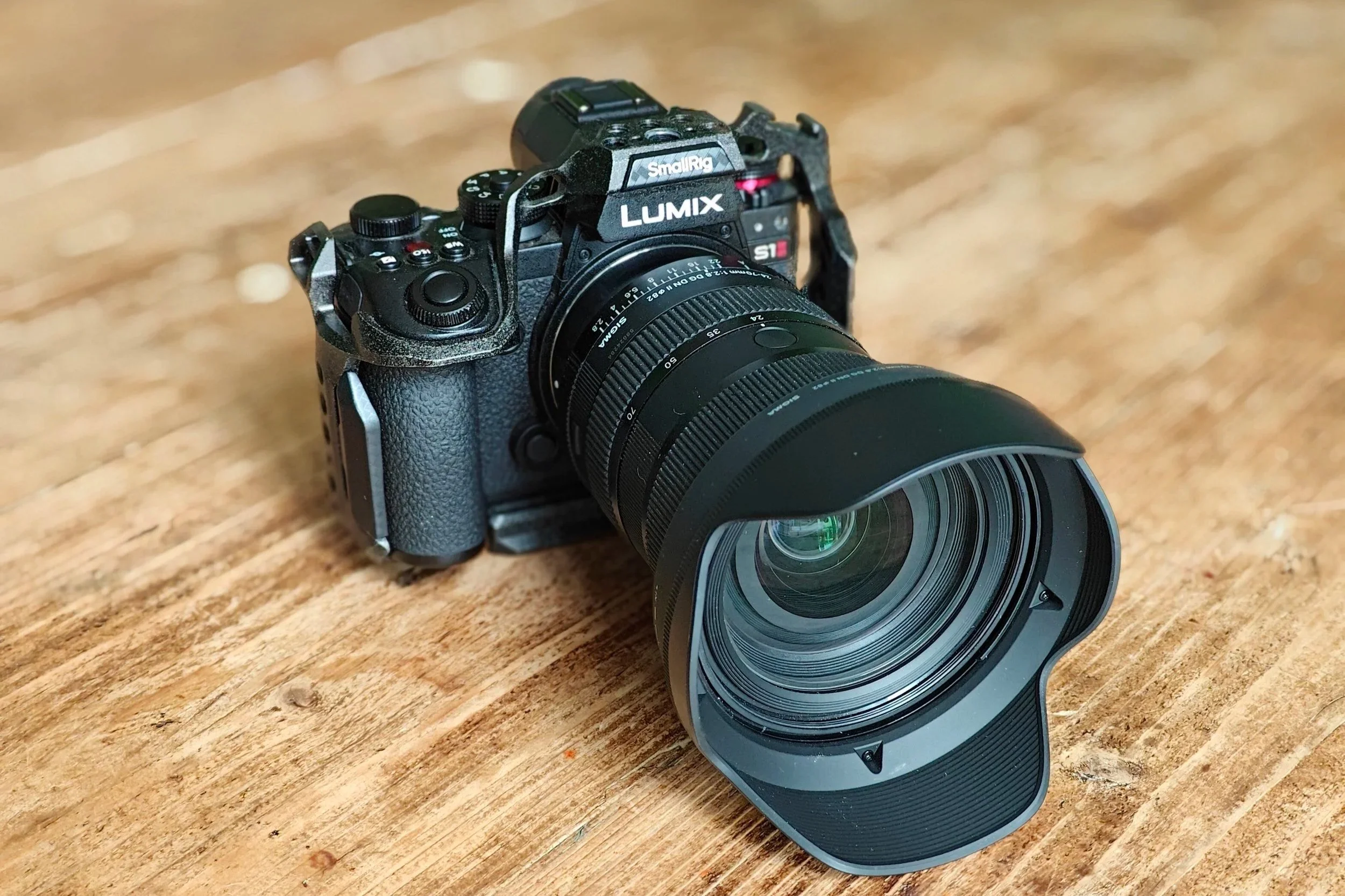
Our Honest Take on the Lumix S1 II
One of the biggest challenges—and distinct pleasures—of running a full-service production house is choosing what to purchase for your kit inventory. When you invest in high-end gear, you’re rarely buying it for just one specific job. Instead, you’re looking for ultimate flexibility and uncompromising quality; a tool that can adapt across a massive range of projects and consistently deliver a true return on investment.
Earlier this year, we faced exactly that dilemma. A client wanted stunning stills captured on location, but rather than blowing the budget on a stills-only body, we set out to find the absolute best hybrid powerhouse on the market—something that would deliver gorgeous photography while adding a top-tier video option to our arsenal.
To look at where we are now, you have to look back. In our view, the video DSLR revolution truly kicked off with the Canon EOS 7D, a moment that completely changed the trajectory of the filmmaking industry. Years later, Sony’s Alpha A7 series became the next massive game-changer, offering low-light capabilities that were astonishingly good. If Moon Carrot were a Sony house, jumping into their ecosystem would have been the obvious route to take. But we have always been massive fans of the video capabilities of Panasonic's GH range—with the legendary GH5 being an absolute standout for us.
With our eyes firmly set on purchasing the L-Mount Blackmagic Pyxis 12K later this year, it made perfect sense to look into Panasonic's full-frame L-mount options to keep our glass interchangeable. After a good deal of research, we bypassed the GH7 and plumped for the Lumix S1 II. The price jump between the two was significant, but the specifications appeared simply too good to overlook.
Having now owned and operated it for six months—dragging it from the sub-zero chill of Arctic Sweden to the intense heat of Southern Spain in Summer and the unpredictable rain of Melbourne in March—here is our unfiltered, real-world review.
The Specs That Actually Matter to Us
• The Brains: A brand-new 24.1MP Full-Frame Partially Stacked CMOS sensor (a massive leap forward for the Lumix family).
• The Canvas: 6K at 30p & 5.1K up to 60p Open Gate (3:2) for ultimate framing freedom.
• The Slow-Mo: 4K up to 120p (with a tiny 1.17x crop) and 1080p up to 240fps.
• The Safety Net: Up to 8.0 stops of In-Body Image Stabilisation (IBIS).
• The Pipeline: Internal Apple ProRes, ProRes RAW, and internal V-Log / ARRI LogC3 (via upgrade key) to slide perfectly into cinema workflows.
Why It’s a Filmmaker’s Dream
1. "Open Gate" Means Storytelling Made Simple
In a digital-first world, the S1 II’s new partially stacked sensor changes the game. Readout speeds are lightning-fast, meaning rolling shutter effects are drastically reduced. Fast pans look beautifully natural, keeping your audience locked into the action rather than distracted by digital artifacts.
But the real magic lies in the 6K and 5.1K Open Gate modes, which utilize the full height of the 3:2 sensor. When we’re building a campaign that demands a gorgeous 16:9 cinematic master and a 9:16 vertical crop for socials, we only frame the shot once. We can extract both deliverables in post without losing the emotional core—or the crisp resolution—of the image. It makes the entire creative process effortless.
2. Beautiful, Malleable Colour with Soul
Activate the Dynamic Range Boost, and you’re handed a genuine 15 stops of dynamic range. While V-Log remains a dream to grade, having internal ProRes RAW and the option for ARRI LogC3 means this camera punches well above its weight class, slotting seamlessly into top-tier post-production pipelines. More importantly, the out-of-the-box colour science feels incredibly human. The skin tones are warm, true-to-life, and carry a organic texture that feels a touch less clinical than generations past.
3. Absolute Handheld Freedom
Panasonic’s image stabilisation remains the gold standard of the industry. Engaging the Boost I.S. allows you to mimic a completely locked-off tripod while standing entirely handheld. For intimate, character-driven documentaries or rapid run-and-gun shoots in bright sunlight, pairing that rock-solid IBIS with the crisp 5760k-dot EVF means we can move light and fast. We get to focus on collaborating with our subjects rather than wrestling with a massive, potentially distracting gimbal setup.
The Real-World Caveats
1. A Shift into Premium Territory
Historically, Lumix has worn the crown of the ultimate "bang-for-your-buck" underdog. The S1 II pushes deeper into premium territory. While its broadcast-ready feature set completely justifies the cost for professional environments, it represents a steeper financial investment for solo operators and indie filmmakers just starting out.
2. The Thermal Reality
We have to be transparent: the S1 II did overheat on us a couple of times on location, even shutting down once right in the middle of a crucial interview. The culprit wasn't necessarily high ambient air temperatures, but rather intense, direct sunlight beating down on the chassis. The good news? We’re problem solvers. By switching the camera’s thermal management from 'Standard' to 'High,' tweaking the fan settings, and keeping up with the latest firmware updates, the issue has disappeared. It’s absolutely something to monitor on hot exterior sets, but (so far) it's easily managed once you know the trick.
3. Powerful, But Crowded Autofocus
We’ve paired our S1 II with a beautiful Sigma lens package, and the combination gives us excellent autofocus performance—especially when the camera is riding on our DJI Ronin RS4 Pro. The eye and subject detection are genuinely impressive. If we have one minor critique, it's that there are almost too many AF options. It lacks the dead-simple intuitive nature of Sony’s system, and adjusting your targeting parameters mid-shot is a bit clunkier than we’d like.
The Moon Carrot Verdict
When we were first researching this camera, one reviewer boldly called it "an ARRI in your pocket." We initially laughed it off as internet hype... but honestly? They weren't far off. The S1 II is a classy, deeply capable piece of kit. It delivers stunning imagery, incredible internal audio capabilities, and the kind of flexibility that makes our lives on set infinitely easier. Keep an eye out for our upcoming head-to-head comparison with the Sony FX3, but for now, we are absolutely thrilled to have this powerhouse in our inventory…..oh, and the stills are great!
The Lumix S1 II is available to rent. Just head to our Hygglo site for pricing and more details.